
The phrase “slipped disc” sounds as though a whole spinal cushion has slid out like a drawer. A more useful picture is a disc that remains between the vertebrae while part of its soft central material extends through its outer layer. The location of that material matters because sensitive nerve roots run nearby. The animation follows this mechanism; it is an explanation, not an individual diagnosis.
Watch the 47-second explanation
The outer ring and soft center
Intervertebral discs sit between spinal bones and help absorb loads during movement. Each has a tough, flexible outer ring, the annulus fibrosus, around a softer nucleus pulposus. In a herniation, some central material pushes through the outer ring. This can develop with age-related changes or follow an injury. The surrounding bones do not have to slide out of alignment for this to happen. Source: AAOS.
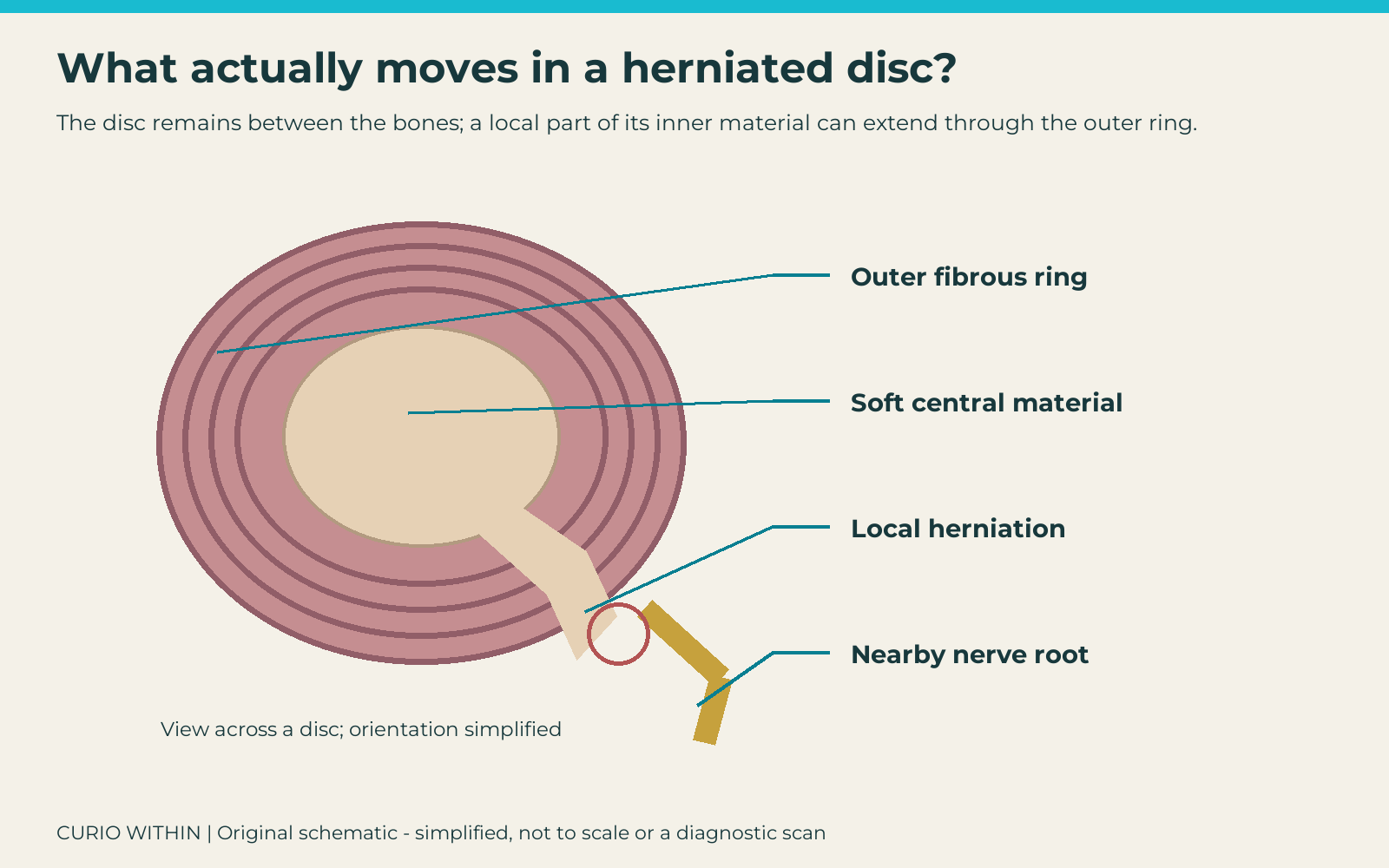
This original schematic shows relationships, not a patient’s scan. The amount of material and the spacing are illustrative.
A bulging disc and a herniated disc are descriptions that may appear in medical discussions. Do not diagnose either by comparing your symptoms with a drawing. A clinician interprets the history, examination and any imaging together. The film concentrates on a localized herniation rather than suggesting every disc change has the same shape.
Why a small change can cause symptoms farther away
The spinal canal and nearby openings contain important nerve structures. A herniation can press on a nerve root, and inflammation can also contribute to irritation. Depending on the affected area, symptoms may include pain, altered sensation or weakness along the territory served by that nerve. A disc change in the lower back can therefore be linked to symptoms felt in the leg. Source: AANS.
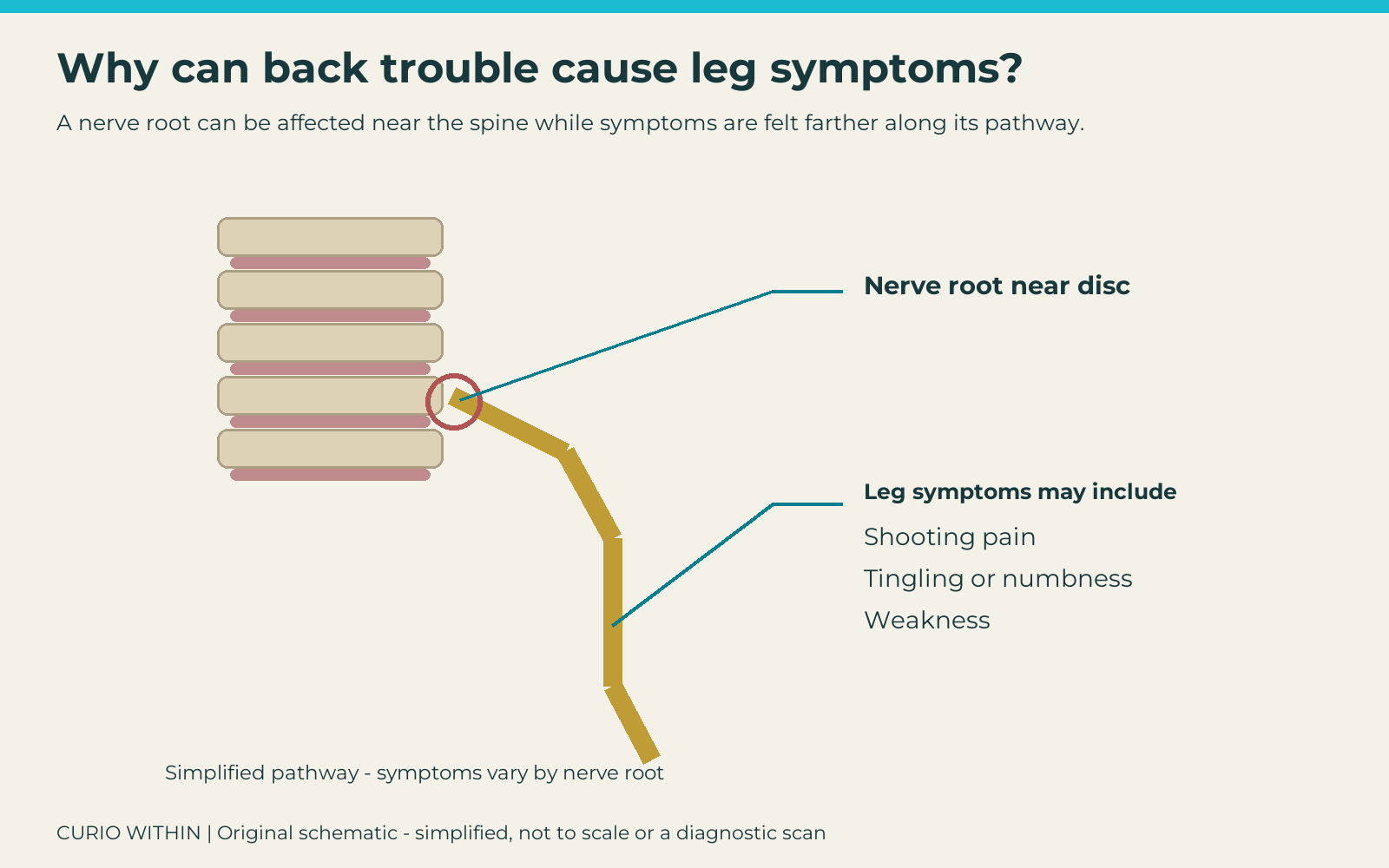
The pathway is simplified. The exact location and pattern of symptoms vary; a yellow line in an animation cannot identify which nerve is affected.
Sciatica commonly affects the buttock and back of one leg, sometimes reaching the foot or toes. People may describe sharp or burning pain, pins and needles, numbness or weakness. Back pain by itself is not the same thing as sciatica. A slipped disc is one cause, but other problems can also irritate the nerve pathway. Source: NHS sciatica.
A disc finding does not always mean pain
Some herniations produce no symptoms. This is why a scan finding alone is not a complete explanation of how someone feels. The size of a protrusion on a simplified image is also not a reliable pain scale. The practical question is whether the clinical findings fit together. Source: AANS.
Assessment and recovery
Many people improve without an operation. Treatment depends on the situation and may include advice about activity, physiotherapy and appropriate pain management. Persistent symptoms, worsening weakness or difficulty with usual activities deserve clinical assessment. There is no single exercise, stretch or online animation that establishes the right treatment for everyone. A clinician may arrange further testing when it is needed. Source: NHS slipped disc.
Symptoms that need emergency attention
With back or leg symptoms, seek emergency care for new difficulty starting urination, inability to urinate, loss of bladder or bowel control, or numbness around the genitals, groin or bottom. Severe or worsening weakness or numbness in both legs is also an emergency warning sign. These can indicate serious compression of spinal nerves. Do not wait for a routine appointment or try to diagnose the cause from this article. Contact local emergency services or attend an emergency department. Source: NHS sciatica.
The point to remember
A “slipped disc” is a name for a disc problem, not proof that the whole cushion has escaped from between the bones. A local herniation and its relationship to a nerve help explain why symptoms can be felt away from the back.
Educational information only. This article has not been independently reviewed by a clinician and does not replace medical assessment. Sources checked 28 October 2026.
Keep your curiosity going
Why Asthma Makes Breathing Hard: Inside a Narrowing Airway
See how tight airway muscles, swelling and extra mucus can make breathing harder during asthma, and learn when symptoms need emergency care.
Read the story →
What Actually Happens Inside Your Brain During a Stroke?
One blocked artery can disrupt a brain network. Follow the chain from blood flow to neurons, then learn why possible stroke signs need emergency care.
Read the story →